The History of Bottarga: From the Nile to the Mediterranean Table
By Bottarga Turkey
Some foods are invented overnight. Others evolve over centuries, shaped by geography, necessity and culture. Bottarga belongs firmly to the latter. Long before refrigeration, Mediterranean communities discovered that one of the sea's most delicate treasures, fish roe, could be preserved with nothing more than sea salt, time and fresh coastal air. What began as a practical method of preservation became one of the region's most celebrated delicacies. Today bottarga appears on the menus of Michelin-starred restaurants and family trattorias alike.
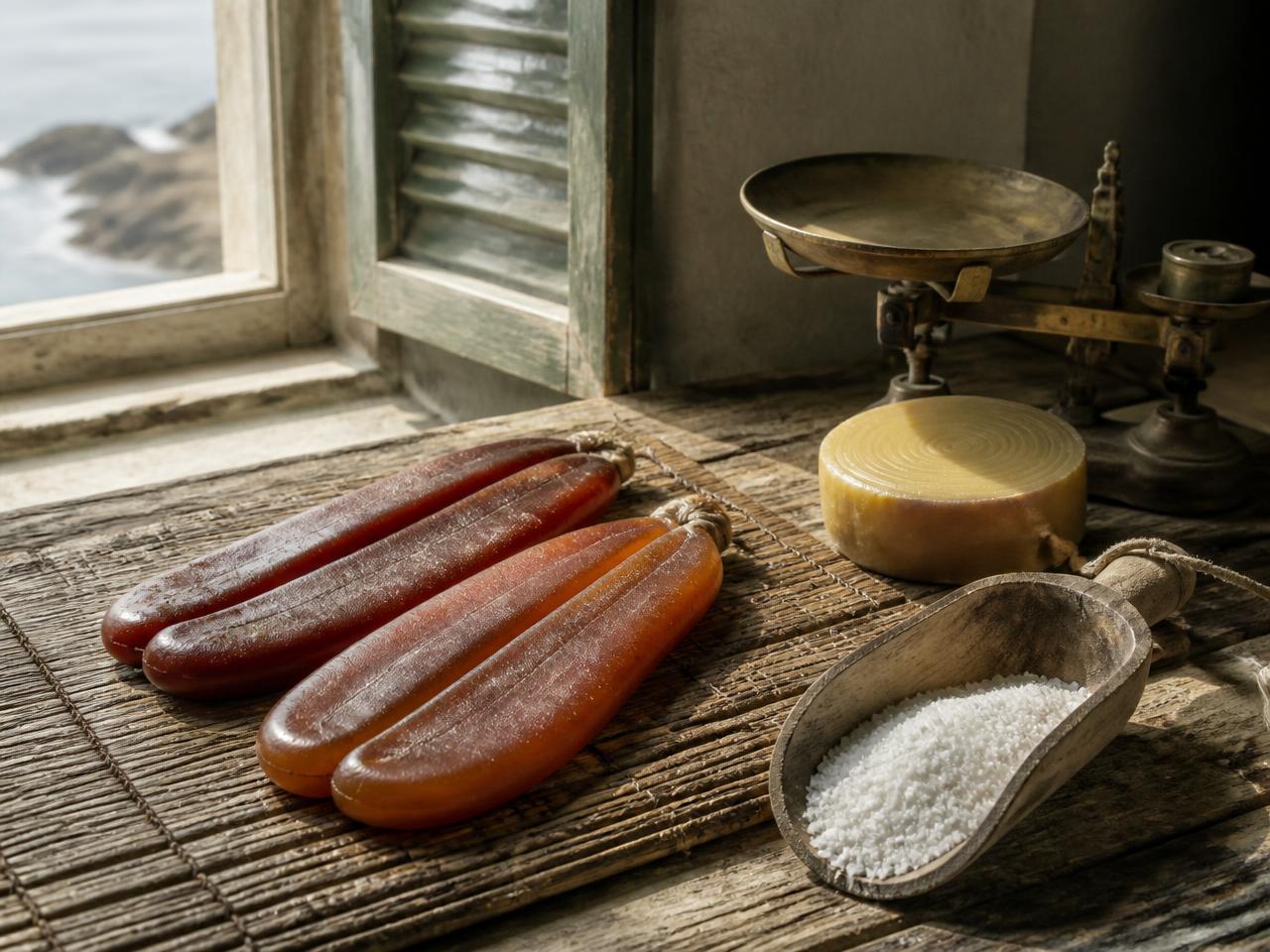
Bottarga has travelled with sailors and crossed empires, and it remains one of the Mediterranean's most treasured culinary traditions.
Where Did Bottarga Originate?
No single country can claim ownership of bottarga. Egypt is the origin most often cited: fishermen along the Nile and the Mediterranean coast salted and dried roe so that valuable protein could be stored and carried long after the fishing season ended. Written evidence for that early period is thin, so treat the attribution as tradition rather than record. The technique itself reflects a pattern seen across ancient coastal societies, which is preserving seasonal abundance for the months ahead.
What is documented is later and textual. The word bottarga is generally traced to Arabic buṭarḫah, itself from a Byzantine Greek compound meaning, roughly, salted egg. A Latin form of that word, ova tarycha, appears in Bartolomeo Platina's De honesta voluptate et valetudine of around 1474, the first printed cookbook in Europe. That places the product, and a name for it, in the written record by the late fifteenth century.
The Mediterranean Spreads the Tradition
As trade flourished, so did culinary knowledge. Phoenician merchants carried preserved seafood across their trading networks. Greek sailors and coastal communities refined local techniques, and cured fish products became part of everyday Roman life. Bottarga took root not in one nation but among communities connected by the sea. Closely related products still exist under different names: Sardinian and Sicilian bottarga, Egyptian batarekh, Greek avgotaraho, and, far outside the region, Japanese karasumi.
A Food Born from Respect for the Sea
The history of bottarga is also a story of thrift. Fishermen used every valuable part of their catch, and the roe was too precious to discard. It was removed carefully, salted, pressed and dried. No artificial ingredients, no machinery, only patience, craft and a close reading of the weather. That philosophy still defines good bottarga.
From Necessity to Delicacy
Bottarga was never created as a luxury. Its original purpose was practical, which was keeping food. Over centuries, cooks found that curing turned roe into something greater than preserved seafood: drying concentrates its natural umami, and a few thin slices lift an entire meal. Fresh bread. Olive oil. Handmade pasta. Seasonal vegetables. By the Renaissance, bottarga was prized by merchants, nobility and coastal households alike.
The Mediterranean Regions That Shaped Bottarga
Sardinia
Sardinia is Europe's best-known producer, with an international reputation for grey mullet bottarga. Its coastal lagoons suit grey mullet, and curing techniques there have passed down through generations.
Sicily
Sicily shares that maritime heritage. Bottarga remains tied to local fishing communities and appears in many traditional Sicilian dishes.
Greece
Across the Greek islands and the western coastline, cured roe is appreciated for its simplicity, often served with olive oil, lemon and rustic bread.
Turkey
Turkey's long Aegean and Mediterranean coastlines have supported grey mullet fisheries for generations. Bottarga from Turkey has been less visible internationally than its Italian counterparts, but growing interest in Mediterranean gastronomy is bringing recognition to Turkish producers, whose access to exceptional raw material places them in the continuing story.
Cured Roe in Turkish Coastal Food Culture
Along Turkey's Aegean and Mediterranean coasts, preserving the sea's seasonal harvest has long been part of everyday life. Salt, sun and fresh coastal air extend the life of fish, and roe holds a place within that heritage: rich in flavour, naturally suited to curing, valued as a delicacy in its own right. Served in small quantities, it fits the Mediterranean way of eating, where a few strong ingredients are shared around the table with bread, extra virgin olive oil, seasonal vegetables and local wine or rakı.
Turkey's southwest, and its lagoons and estuaries in particular, is associated with seasonal grey mullet fisheries. During the autumn migration, fishermen harvest mature mullet whose roe is cured by methods that have changed little. The Köyceğiz and Dalyan lagoon system in Muğla is the part of this picture with the most published documentation behind it, including a Slow Food Ark of Taste entry describing roe sacs salted, dried and coated in beeswax by a local fishermen's cooperative.
Bottarga in Contemporary Turkish Cuisine
As appreciation for Mediterranean cooking grows, bottarga is appearing on the menus of Turkey's leading restaurants and smaller kitchens. Chefs value it for depth without weight. It is grated finely over fresh pasta and risotto, shaved onto raw or cured seafood, folded into butter, or served in thin slices with good bread and olive oil as a cold opening. It works as a finishing ingredient rather than a centrepiece: a small amount adds umami, gentle salinity and length while the other flavours stay in view.
Why Grey Mullet Is the Preferred Choice
Bottarga can be made from several species, but grey mullet became the benchmark. Its roe balances texture, flavour and colour, giving a bottarga that is refined rather than overpowering: rich in umami, delicately saline and easy to use across a menu. That is why grey mullet remains the preferred choice for many Mediterranean chefs.
Bottarga in Modern Cuisine
Modern cooking celebrates bottarga for what it does to simple dishes. Grated over fresh pasta. Shaved onto warm sourdough. Finished with olive oil and lemon. Folded into creamy scrambled eggs. Its role has changed little over the centuries. Only the kitchens have become more sophisticated.
A Living Mediterranean Tradition
The story is still being written. Producers across the Mediterranean keep traditional curing methods while working to modern food safety standards and more careful fishing practice. For anyone who cooks, bottarga offers more than flavour: patience over speed, craft over volume, heritage over trend. Every slice carries a long maritime history with it.
What Is Available in Turkey
- Whole smaller lobes, usually vacuum-packed
- Larger whole lobes protected in wax
- Grated bottarga in jars, sold for finishing
How to Buy or Source It
Look for a clear label: species, origin, net weight, ingredients, storage instructions and a date. A specialist delicatessen or a producer selling direct will answer questions about how a piece was cured; a seller who cannot tell you what fish it came from is not a good starting point. For professional volumes, our trade page collects the details a supplier needs in one enquiry.
- How old is bottarga?
- Curing fish roe is an old coastal practice, often traced to Egypt, though the earliest centuries are not well documented. The firmest dates come from language and cookbooks: the product and a name for it are in the European written record by the late fifteenth century.
- Which country invented bottarga?
- There is no definitive answer. Egypt is often cited as the earliest known home of cured fish roe, but bottarga developed across many Mediterranean cultures, including those of Italy, Greece and Turkey.
- Why was bottarga originally made?
- It began as a practical way to preserve valuable roe before refrigeration. Over time people came to prize the flavour curing created, and a preserved food became a delicacy.
- Is bottarga still made traditionally?
- Yes. Many producers still salt, press and air-dry the roe sac, combining those methods with modern food safety practice for consistent quality.
- Why is bottarga considered part of Mediterranean cuisine?
- Its production methods and culinary use were shaped by Mediterranean coastal communities over a long period, and it remains one of the region's most enduring food traditions.
Sources
The references below support the documented claims on this page. Where a claim is not covered by one of them, it is presented as tradition, interpretation or brand storytelling.
- 1.Bartolomeo Platina, De honesta voluptate et valetudine, c. 1474. The earliest printed European cookbook, in which the Latinised Greek form ova tarycha appears. en.wikipedia.org
- 2.Etymology of bottarga: Arabic buṭarḫah from Byzantine Greek ᾠοτάριχον ('salted egg'), with the Italian form datable to around 1500. en.wikipedia.org
- 3.Slow Food Foundation for Biodiversity, Ark of Taste: 'Haviar': dried grey mullet roe sacs from Dalyan, Muğla, salted, dried and coated in beeswax by a local fishermen's cooperative. fondazioneslowfood.com
- 4.U. Çelik, C. Altınelataman, T. Dinçer and D. Acarlı, 'Comparison of Fresh and Dried Flathead Grey Mullet (Mugil cephalus, Linnaeus 1758) Caviar by means of Proximate Composition and Quality Changes during Refrigerated Storage', Turkish Journal of Fisheries and Aquatic Sciences, 2012. doi.org
- 5.Ü. Ateş (supervisor Prof. Dr. T. Baygar), 'Determination of the chemical composition and quality of the caviar obtained from the ovaries of mullet captured in the Köyceğiz Dalyan (Muğla)', M.Sc. thesis no. 514722. tezara.org
- 6.Microbiological, nutritional and sensory characterisation of bottarga from Mugil cephalus produced in Sardinia, Applied Sciences (MDPI), 2025. Peer-reviewed description of a contemporary Mediterranean production process. mdpi.com
- 7.Oxford English Dictionary, entry for 'botargo': the word's passage through Mediterranean languages.